REVIEW · MAUI
Maui: Top Gun Paragliding Tandem Flight
Book on GetYourGuide →Operated by Paraglide Maui LLC · Bookable on GetYourGuide
There’s something special about flying over Maui’s volcano slopes. This Maui tandem paragliding flight trades road time for sky time, lifting you off a 6,500-foot launch for long, clear views over the central valley and out toward other Hawaiian islands.
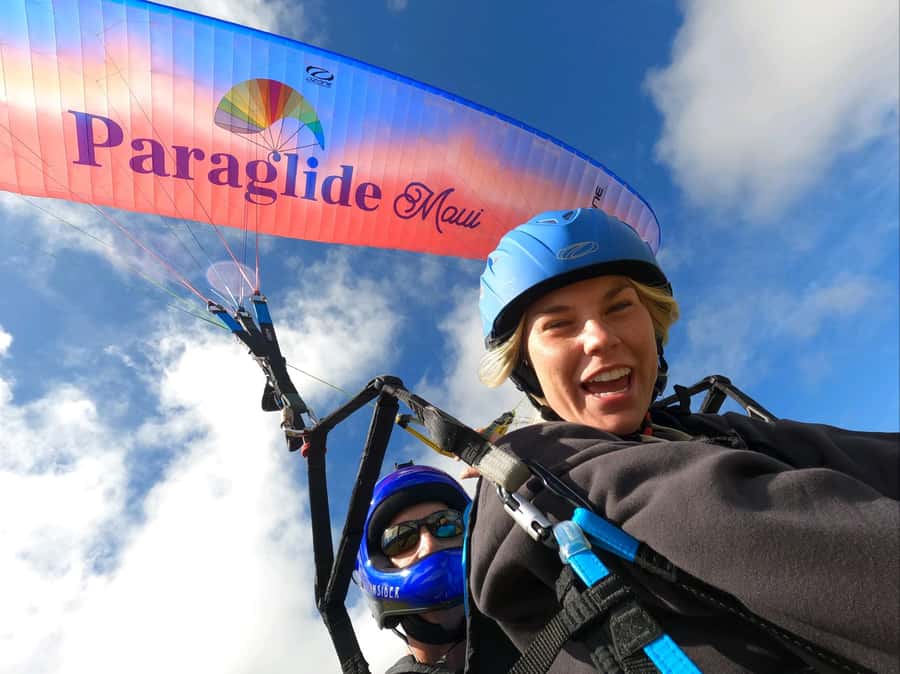
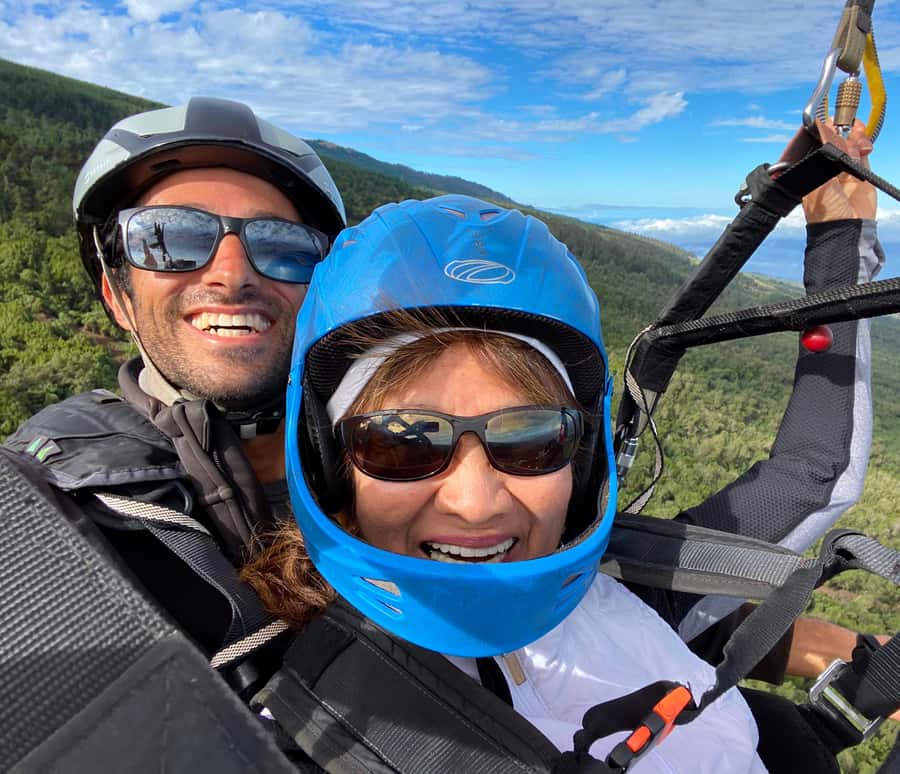
I love the way this trip builds in choice: you can keep it smooth and scenic, or add more punch with high-G roller-coaster style moves if you’re in that mood. I also love that you get in-flight photos taken by your instructor at no extra cost, plus you can shoot your own video or photos on your phone or compact camera.
One drawback to plan around: it’s not suitable for kids under 14, and there’s a strict weight limit of 300 lbs (136 kg).
In This Review
- Quick hits before you go
- Entering the day: Alii Kula Lavender Farm to your launch site
- The Haleakalā launch: 6,500 feet of wow before you even fly
- What the tandem flight feels like (and what you control)
- Photos that actually matter: what’s included and why it’s worth it
- The Alii Kula Lavender Farm bonus: a soft landing after sky time
- No motors, no noise: the real reason this feels different
- Price and value: is $413 per person fair for Maui paragliding?
- Safety, instruction, and the condition-first approach
- What to wear and bring for a Haleakalā tandem flight
- Who should book this Maui tandem paragliding flight
- Should you book Paraglide Maui’s Top Gun tandem flight?
- FAQ
- Where is the meeting point for Maui tandem paragliding?
- How long does the experience take?
- What’s included with the tandem paragliding flight?
- Are food and drinks included?
- Do I need my own camera?
- What kind of flight is it: cliff jump or run-and-fly?
- What are the age and weight limits?
- What language are the instructors?
- What should I wear and bring?
- What happens if flight conditions are not good?
Quick hits before you go
- Run-and-fly, not cliff-jump: you don’t jump off; you run down the hill and launch.
- No motors, no noise: you’re gliding quietly through the air like a bird.
- Bi-coastal views from Haleakalā: Maui’s central valley spreads out below you, with other islands visible in the distance.
- Instructor photo service included: inflight shots are taken by your instructor and shared after landing at no add-on cost.
- Optional adrenaline: calm glides or more intense maneuvers, depending on conditions and what you want.
- Lavender farm add-on: entrance to the nearby Alii Kula Lavender Farm is included.
Entering the day: Alii Kula Lavender Farm to your launch site
Your day starts at the Alii Kula Lavender Farm area. Put that name into your GPS and look for the Paraglide Maui flags, plus a green picnic table with a red umbrella just before you reach the lavender-farm entrance. It’s an easy checkpoint, which matters when you’re dealing with early-day driving and changing light on Haleakalā.
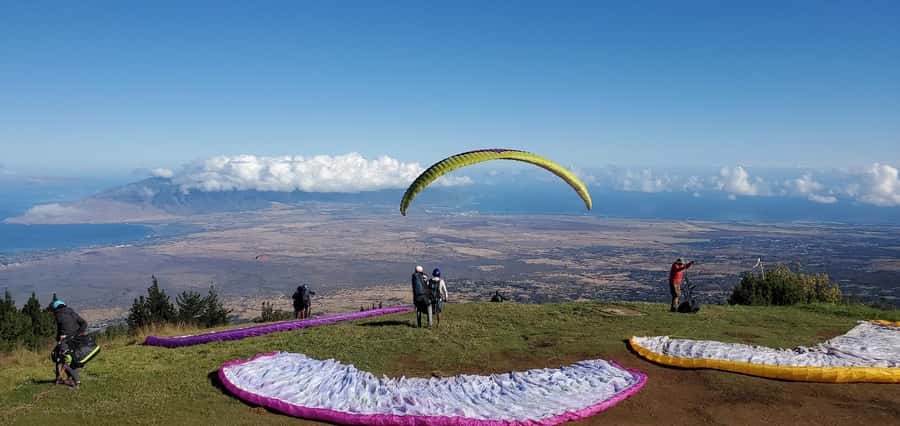
From there, you’ll ride up the slopes of Mount Haleakalā. The route passes through Kaonoulu Ranch pasture land, then through the Haleakalā Watershed Preserve forest before reaching the Ferns launch site at an elevation of about 6,500 feet.
Why this drive is part of the experience: it’s not just transportation. You’re already moving through different Maui “faces” before you fly. You get a sense of the island’s scale and the dramatic vertical shift that makes paragliding possible here. Also, this is one of those activities where arriving focused helps; once you’re on a hillside, you’ll quickly realize how much airflow and wind matter, and why instructors pay attention to launch conditions.
You can also read our reviews of more tours and experiences in Maui.

The Haleakalā launch: 6,500 feet of wow before you even fly
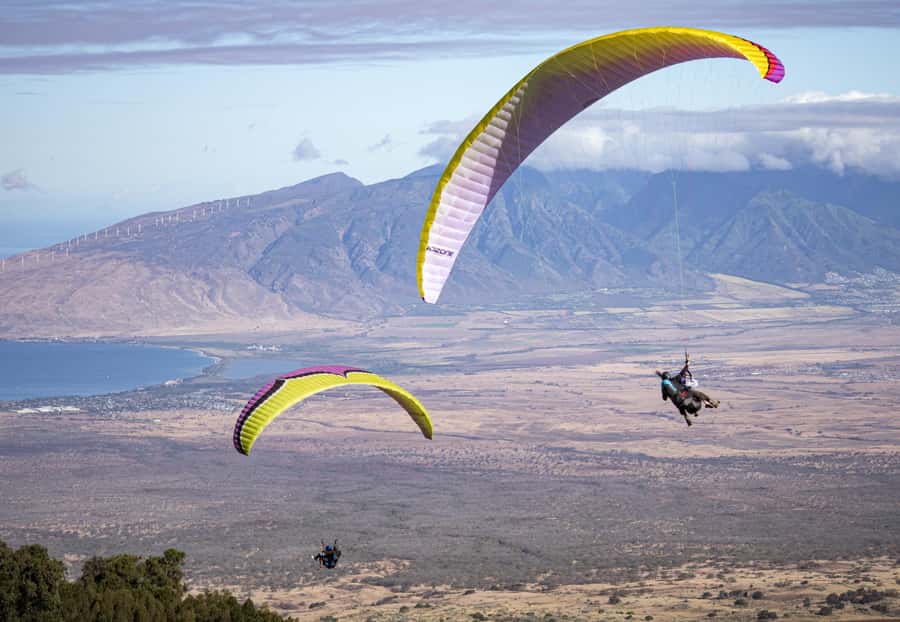
At the Ferns launch site, you’ll get set up with your tandem instructor and go through the basics so you know what’s happening before you commit your weight to the harness.
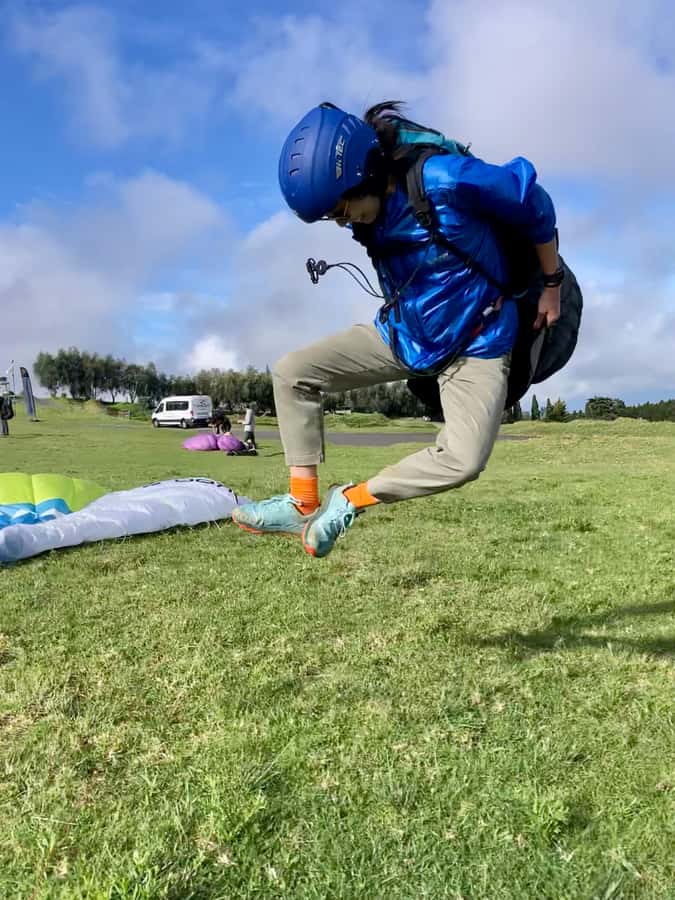
Then comes the moment that makes this activity easy to picture: there’s no cliff jump. You run down the hill and fly.
Right away, the sky opens. From this high elevation, you get sweeping bi-coastal views over Maui’s central valley. Depending on weather and visibility, you can also see three other Hawaiian islands off in the distance. That’s the payoff you’re paying for: a moving vantage point with enough height to see far and enough time in the air to actually enjoy it.
Practical tip: bring your camera ready. You’ll want to capture the first broad panorama while you’re still landing your breathing and settling into the harness. You can take your own shots with a phone or compact camera, and your instructor will also take photos while you’re inflight.
What the tandem flight feels like (and what you control)
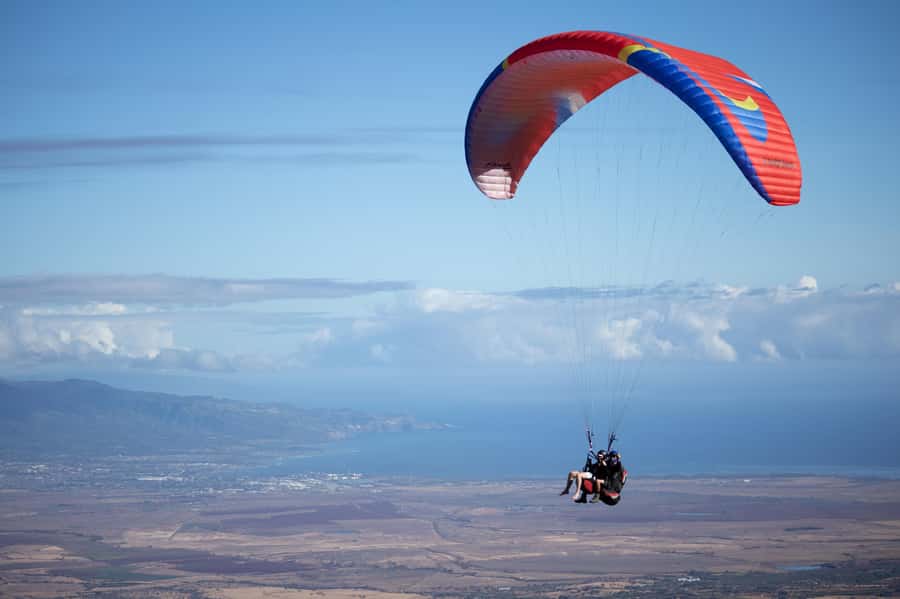
This is a tandem flight, so you’re not steering your own wing. Your instructor handles the technical side, including flight adjustments based on conditions. But the experience can still feel personal.
One of the best parts is that the flight is adaptable. With ample altitude at your disposal, the instructor can tailor the flight to your preferences, including a more relaxed glide focused on scenery or a more thrilling ride with high G maneuvers (the kind that feel like a roller coaster).
You’ll likely notice two different “modes” of enjoying the air:
- Scenic mode: you slow down, look longer, and let the views do the talking. This is ideal if you’re there for the Maui postcard angle—valley below, island horizons stretching out, and a quiet glide with no motors or noise.
- Adrenaline mode: you lean into the thrill and let the instructor demonstrate more intense maneuvers. It’s not just for thrill seekers; it can also be a confidence booster if you want to feel what controlled flying is like.
The vibe across the board is calm and professional. In real-world accounts of this operator, instructors like Paul are praised for staying steady, explaining clearly, and making the whole thing feel smooth even when conditions require changes.
Photos that actually matter: what’s included and why it’s worth it
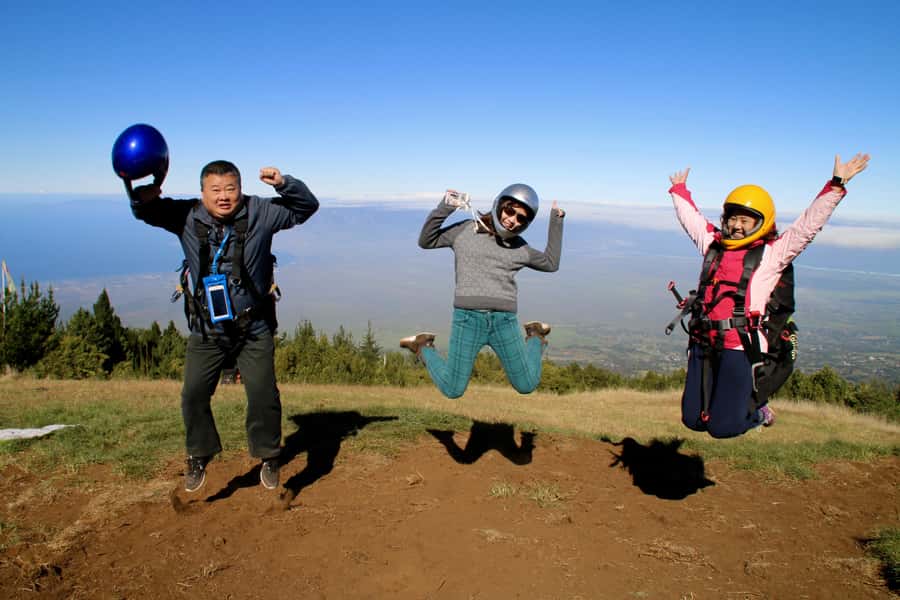
I’m a firm believer in building memories in two ways: you enjoy the view in real time, then you also capture the evidence. This experience handles the second part for you.
Your package includes photos taken by your instructor during the flight. You receive them after landing with no additional cost. That’s a big deal because paragliding doesn’t give you much margin for fiddling with a camera once you’re airborne.
Meanwhile, you’re free to bring your own phone or compact camera and take shots yourself. I’d treat your own camera as the bonus layer. Let your instructor do the tracking and timing for the best angles, and you focus on holding your gaze outward.
If you’re photo-minded, this is the kind of included service that turns a pricey activity into a better value. You’re not just paying for the flight—you’re also paying for the “keep-sake” side to be handled.
The Alii Kula Lavender Farm bonus: a soft landing after sky time
After your flight, you’re not headed straight back to the highway. Entrance to the neighboring Alii Kula Lavender Farm is included.
Why this matters: you get a chance to transition from high-energy sky time into something slower and tactile. Lavender-farm stops also tend to work well for groups with different energy levels—one person can linger with photos and scenery, and another can just enjoy the walk and the post-flight decompression.
It’s not a replacement for food (there isn’t one included), but it gives you structure to the day, so the whole outing feels like an experience rather than just a quick lift and gone.

No motors, no noise: the real reason this feels different
A lot of tourism sells you motion. This sells you calm motion.
The flight is motor-free and designed to be quiet. No engine noise. No constant mechanical vibration. Just the soundscape of breezes and the awareness that you’re moving without a machine pushing you around.
That changes the emotional tone. I find that quieter adventures make people talk less and watch more. You’re not forced to perform. You’re allowed to simply notice Maui’s scale—valley depth, ridgelines, cloud layers, and the way horizons shift as you drift.
And because it’s tandem and instructor-led, you don’t have to worry about turning it into a survival challenge. You can treat it as a guided experience where your main job is to look and enjoy.
Price and value: is $413 per person fair for Maui paragliding?
At $413 per person for a roughly 2-hour total experience, this isn’t a budget impulse buy. So the question is whether the value matches the cost.
Here’s what you’re getting that supports the price:
- Tandem flight off Haleakalā with high elevation and big-view geography (this isn’t a flat-field fly).
- Instructor-led flight with the option to tailor the intensity, from relaxed gliding to higher-G maneuvers.
- Included inflight photos taken by your instructor at no extra cost. That’s a real, tangible add-on.
- Alii Kula Lavender Farm entrance included, giving you another experience block before you wrap up the day.
When paragliding is priced this way, value usually comes from three places: quality of instruction, real flight time from a dramatic launch location, and included extras that reduce your own hassle. Based on the way instructors run this operation and the repeated mention of smooth rescheduling when conditions aren’t good, you’re paying for more than just a ticket—you’re paying for a professional setup that tries to protect the experience from weather problems.
Safety, instruction, and the condition-first approach
Even when an activity looks simple, good flying depends on reading wind and timing. This operator is known for being careful with conditions. On at least one booking, the original day had unsuitable flight conditions due to wind, and the booking was re-scheduled for the next day with perfect weather and a great flight.
That kind of approach matters for you. You don’t want a team that pushes forward no matter what. You want a team that waits for a safe window and keeps the experience intact.
In the same spirit, the instructors are repeatedly described as calm and clear. Paul comes up in particular as someone who explains what you’re doing and why. That matters because your comfort often improves right after you understand the plan: what you’ll feel at takeoff, what you’ll be looking at, and how the flight will be adjusted once you’re airborne.
What to wear and bring for a Haleakalā tandem flight
This is one of those activities where comfort makes everything easier. You’ll want:
- Comfortable clothes suitable for the activity
- Sunscreen, since you’ll be out in the sun
- A camera (phone or compact) for the views
Because you’re launching at about 6,500 feet, plan for changing conditions. You might find it helpful to dress so you can handle sun and breeze without fuss. Tight gear isn’t the goal here; easy comfort is.
If you’re the type who cares about photos, also think about how you’ll hold your camera safely while you’re strapped in and moving through takeoff. The included instructor photos reduce pressure on you to get everything yourself.
Who should book this Maui tandem paragliding flight
This activity fits best if you:
- Want a once-in-a-lifetime Maui experience that goes beyond beaches and sightseeing drives
- Like the idea of seeing Maui from above, with wide views and horizons
- Enjoy either relaxed scenery or controlled adrenaline, since the flight can be tailored
- Want included inflight photos so you don’t have to worry about capturing everything on your own
It may not fit you if:
- You’re traveling with children under 14
- You’re over 300 lbs (136 kg)
- You want a completely slow, low-stimulation activity. This includes takeoff thrills, and some people will prefer the calmer glide over the high-G option
If you’re nervous about flying, the tandem format and clear instruction from pilots like Paul can make a big difference. You’re strapped in with someone who runs the show, and you get a chance to steer for a bit in some cases, which helps the experience feel more than just a passive ride.
Should you book Paraglide Maui’s Top Gun tandem flight?
If you’re craving a Maui experience with real vertical drama, this is a strong choice. The combination of Haleakalā launch height, bi-coastal views, optional adrenaline, and included instructor photos makes it feel like more than a novelty. Add the Alii Kula Lavender Farm entrance and you have a day with two distinct experiences—sky, then calm.
You should skip it if the restrictions (under-14 minimum or the 300 lbs cap) affect you, or if weather concerns would be a dealbreaker. The good news: this operator appears willing to rebook when conditions aren’t safe for flying, so you’re not just gambling that you’ll get your flight no matter what.
FAQ
Where is the meeting point for Maui tandem paragliding?
Meet at the Alii Kula Lavender Farm area. Use the name Alii Kula Lavender Farm in your GPS, then look for the Paraglide Maui flags and a green picnic table with a red umbrella just before the lavender-farm entrance.
How long does the experience take?
Plan for about 2 hours in total.
What’s included with the tandem paragliding flight?
You get the tandem paragliding flight, photos taken by your instructor, and entrance to the neighboring Alii Kula Lavender Farm.
Are food and drinks included?
No, food and drinks are not included.
Do I need my own camera?
You should bring your camera if you want to take your own photos. Your instructor also takes inflight photos that are included.
What kind of flight is it: cliff jump or run-and-fly?
It’s a run down the hill and fly like a bird. There is no jumping off a cliff.
What are the age and weight limits?
Children under 14 are not suitable, and people over 300 lbs (136 kg) are not suitable.
What language are the instructors?
The instructor is listed as English.
What should I wear and bring?
Wear comfortable clothes for the activity, bring sunscreen (recommended), and bring a camera to capture the views.
What happens if flight conditions are not good?
If conditions aren’t good for a flight on your booking date, you may be able to reschedule for another day, based on how this activity has been handled when wind was too strong.